
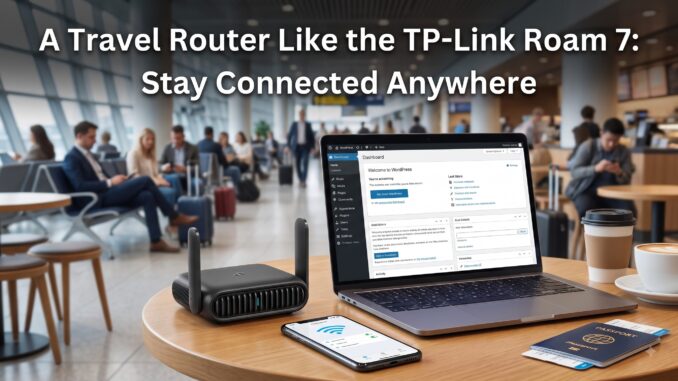
If you’ve ever connected to the free Wi-Fi at an Indian railway station, airport lounge, or budget hotel and wondered, “Is this actually safe?” — your instincts were right to be suspicious. Public Wi-Fi in India is everywhere now, from Café Coffee Day to Indigo airport lounges, but open networks remain one of the easiest places for cybercriminals to intercept your data. A travel router is one of the smartest, most underrated gadgets you can carry on any trip — domestic or international.
Why Travellers Are Especially Vulnerable on Public Wi-Fi
India’s public Wi-Fi landscape has expanded rapidly, thanks to initiatives like PM-WANI and railway station hotspots from RailWire. More access sounds like a win — and it largely is — but wider availability also means a wider attack surface. When you log into your bank’s UPI dashboard or your company’s VPN over an unsecured hotel network, every packet of data you send could theoretically be sniffed by someone else on the same network.
There’s another very Indian problem: juggling multiple devices. A typical family travelling together might have four smartphones, a tablet, and a laptop all needing internet simultaneously. Signing each device into the hotel’s captive portal individually — especially when some networks time out or require OTP verification — is genuinely painful. Smart TVs, gaming consoles, and older laptops often can’t even navigate those login screens at all.
Yes, you could use your mobile data. Jio, Airtel, and Vi all offer reasonably priced data packs. But if you’re travelling internationally — say, to Dubai, Thailand, or the UK — roaming charges still add up fast, even with international packs. A travel router lets you tap into the hotel’s broadband once and share it cleanly across all your devices.
What a Travel Router Actually Does (and What to Look For)
A travel router sits between your devices and the public network. You connect the router to the hotel Wi-Fi or an Ethernet port once, and then every phone, tablet, and laptop in your group connects to your router’s private network — not the public one directly. This does several things at once:
- Security: Your devices never touch the public network directly. The router handles that exposure.
- Privacy: Many travel routers support VPN protocols like OpenVPN and WireGuard, encrypting all outgoing traffic.
- Convenience: One login for the whole group, across all devices, including gadgets that can’t handle captive portals.
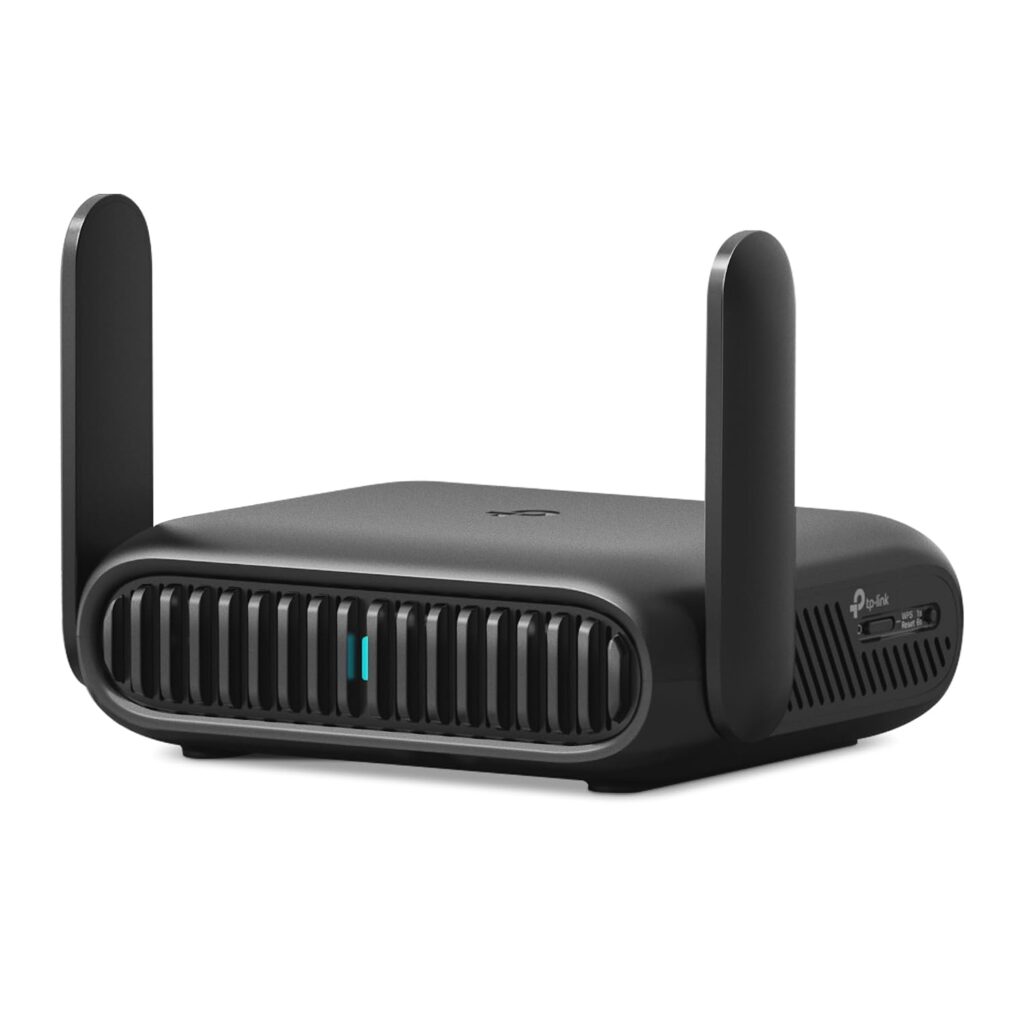
One premium option worth knowing about is the TP-Link Roam 7 (model TL-WR3206BE). It’s a Wi-Fi 7 travel router — yes, Wi-Fi 7 in a palm-sized device — with combined speeds up to 3.6Gbps across 2.4GHz and 5GHz bands. It has two Ethernet ports (one is a 2.5G WAN port), a USB 3.0 port for file sharing or phone tethering, and runs off a USB-C power bank, so you don’t need a wall socket. It can handle up to 90 simultaneous device connections and supports both OpenVPN and WireGuard. Physical dimensions are roughly 13 × 9.3 × 3.8 cm — smaller than most paperback novels.
That said, the TP-Link Roam 7 is positioned as a premium product. For Indian buyers on a tighter budget, there are alternatives worth exploring. The TP-Link TL-WR902AC (AC750, often available on Amazon India for around ₹1,500–₹2,000) is a popular, affordable pick that handles the basics well. The GL.iNet GL-MT300N-V2 (“Mango”) is another budget-friendly travel router beloved by privacy-conscious users for its built-in OpenVPN support — it frequently appears on Amazon India for under ₹3,000. These won’t match the Roam 7’s Wi-Fi 7 speeds or 90-device capacity, but for a family of four or a solo work traveller, they do the job admirably.
Is a Travel Router Worth Carrying on Indian Domestic Trips Too?
Absolutely. Even within India, hotel Wi-Fi quality is wildly inconsistent. Budget properties in Tier-2 cities often provide weak signals that barely reach the room. A travel router with a repeater mode can strengthen that signal and distribute it better. And for business travellers hopping between co-working spaces or client offices, having your own secure network bubble is increasingly non-negotiable.
At its core, a travel router is cheap insurance — whether it’s a ₹1,500 budget option or a premium Wi-Fi 7 model. Given how much sensitive data we move over the internet daily — UPI payments, work emails, OTPs — treating public Wi-Fi as inherently hostile and routing around it is just good digital hygiene in 2026.
Leave a Reply