
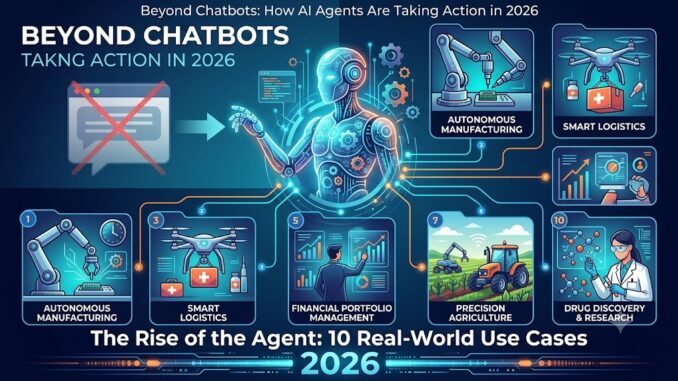
The Rise of the Agent: 10 Real-World Use Cases for AI Agents in 2026
We have officially moved past the era of simple, passive chatbots. While generative AI gave us the ability to draft emails and create images, we are now entering the era of “Agentic AI.”
AI agents are distinct because they don’t just provide information—they perform tasks. These autonomous systems are capable of reasoning, using tools, and executing multi-step workflows to achieve specific goals with minimal human intervention. As we sit here in mid-2026, these agents have moved from experimental sandboxes into the backbone of enterprise and personal productivity.
Here are 10 practical use cases currently defining the agentic revolution.
10 Real-World Use Cases for AI Agents
1. Autonomous Personal Assistants Modern agents handle the “mental load” of daily life. Beyond just setting reminders, these agents act as intermediaries, coordinating schedules across different platforms, booking complex multi-leg travel, and negotiating service contracts without requiring constant oversight.
2. Software Development Coding agents have evolved into full-fledged junior developers. They don’t just suggest snippets; they can analyze a codebase, write new features, run automated tests, and even handle PR reviews, significantly reducing the deployment time for software teams.
3. Customer Support The days of repetitive chatbot loops are ending. Advanced agents now resolve complex queries by accessing backend systems, processing refunds, updating account information, and managing cancellations independently, only escalating to humans when genuine empathy or high-level judgment is required.
4. Supply Chain Management Agents act as the glue between disparate logistics systems. They monitor global shipping routes, predict inventory shortages based on market trends, and autonomously initiate reorders with suppliers, keeping supply chains fluid without human micro-management.
5. Financial Analysis & Compliance In the fast-paced financial sector, agents provide continuous auditing. They monitor transactions in real-time, flag potential compliance breaches against changing regulations, and generate detailed reports for oversight bodies, effectively mitigating risk 24/7.
6. Healthcare Triage Agents alleviate administrative burnout by handling patient intake, summarizing electronic health records for doctors, and navigating insurance verification processes. This allows medical professionals to focus on care rather than paperwork.
7. Content Lifecycle Management Content creation is no longer just about generating text. Agentic workflows now handle the entire pipeline: identifying SEO opportunities, drafting content, managing image generation, and scheduling distribution across multiple platforms based on engagement data.
8. Cybersecurity Monitoring Agents provide a proactive defense layer. By autonomously simulating attacks to find vulnerabilities and initiating containment protocols the moment an anomaly is detected, they provide an “immune system” for enterprise networks.
9. Data Cleaning & Integration Data scientists often spend hours cleaning datasets. Agents now automate the normalization of messy, unstructured data from disparate sources, ensuring that enterprise data warehouses remain consistent and ready for analysis.
10. Scientific Research In laboratory settings, agents are accelerating innovation by autonomously searching through thousands of research papers to synthesize findings, proposing new hypotheses, and even controlling automated lab equipment to run initial experiments.
The Future of Human-Agent Collaboration
The true potential of AI agents does not lie in replacing humans, but in elevating them. By delegating high-volume, repetitive, or data-heavy tasks to autonomous agents, we free up human potential for higher-order creativity, strategy, and ethical decision-making.
As these systems become more integrated into our workflows, the challenge will remain one of oversight—ensuring these agents operate within defined parameters and maintain the transparency necessary to build lasting human trust. We aren’t just building tools anymore; we are building partners.
Leave a Reply